
Bioluminescence
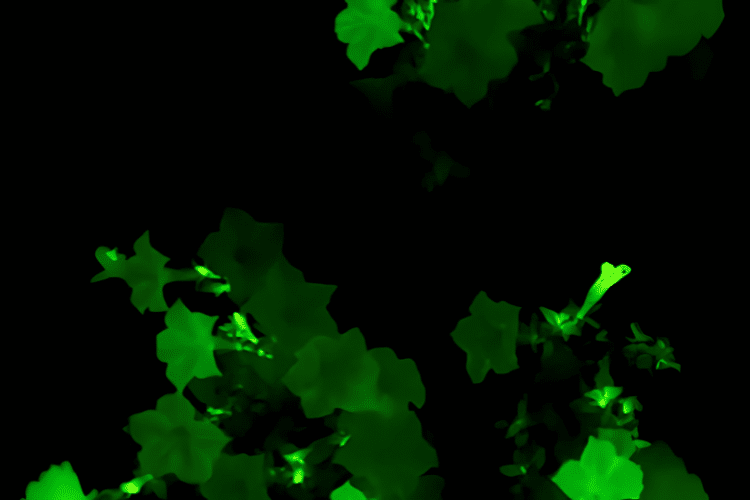
This is a picture of my new Firefly Petunia on the patio (taken at night under a dark blanket). The firefly petunia is bioluminescent – meaning it glows in the dark! This petunia was created by modifying its genome with some bioluminescence genes from a mushroom. Bioluminescence is the production of light by living organisms. It’s a chemical reaction in which an enzyme (luciferase) catalyzes the oxidation of a light-emitting molecule (luciferin).
I am fascinated by bioluminescence and have come across it several times in my travels. When Vicky and I were in the San Juan Islands in Washington we took a nighttime kayak adventure to a special place with bioluminescent algae in the water. When disturbed the microorganisms would emit a brief glow – creating a “pixie dust” effect as we ran our paddles through the water. Cool.
I also came across bioluminescence in the famous Monterrey Aquarium which was putting on an exhibit about the deep ocean that included many bioluminescent sea creatures and jellyfish. You could literally see the pulsing light travelling through their bodies (see video below). And of course many of us grew up chasing fireflies and their pulsating glow in the backyard at night.
Bioluminescence is used in biomedical research, such as imaging cancer cells, tracking infections, and developing biosensors for detecting toxins. Firefly luciferase is widely used to study gene expression.
It was long assumed that access to sunlight was a fundamental requirement for life. Finding bioluminescence in life forms in the very deep ocean has forced us to reconsider that assumption.
Thank you God for bioluminescence.
0 Comments